
Why crawl space insulation fails in Charleston
Most older crawl spaces in the Lowcountry have the same insulation: fiberglass batts stuffed between the floor joists. In a dry climate that can work for years. In Charleston it often does not.
Fiberglass absorbs moisture from humid air. Once damp, it loses most of its insulating value and gets heavy. Gravity pulls it away from the subfloor, and it ends up sagging, fallen or lying on the ground. Worse, it can hold moisture against the wood, which speeds rot and gives mold a place to grow. What looks like an insulation problem is really a moisture problem the insulation could not survive.
When we pull out failed insulation, we usually find one of three things: it was installed in a vented crawl space where humid air saturated it, it was damaged by a leak or flood, or it was held up by wire hangers that rusted through. Replacing it with the same product tends to repeat the failure.
Where insulation goes in a crawl space
There are two main approaches, and the right one depends on whether the crawl space is vented or sealed.
Insulating the floor above a vented crawl space. This is the traditional method. The insulation sits in the floor system, between the joists, so the living space is separated from the unconditioned crawl space below. It can work in a dry, ventilated space, but it leaves the crawl space itself exposed to humidity and the ductwork and plumbing in the cold side of the insulation.
Insulating the foundation walls of a sealed crawl space. This is the modern approach. The crawl space is sealed and conditioned, and the walls are insulated, so the crawl space stays close to the temperature of the home. The ductwork and plumbing are inside the thermal envelope, and the floor above stays warmer in winter and cooler in summer.
For most Charleston homes with moisture problems, we recommend sealing the crawl space and insulating the walls. It deals with the cause of the damp and solves the insulation problem at the same time. See full encapsulation for how the pieces fit together.
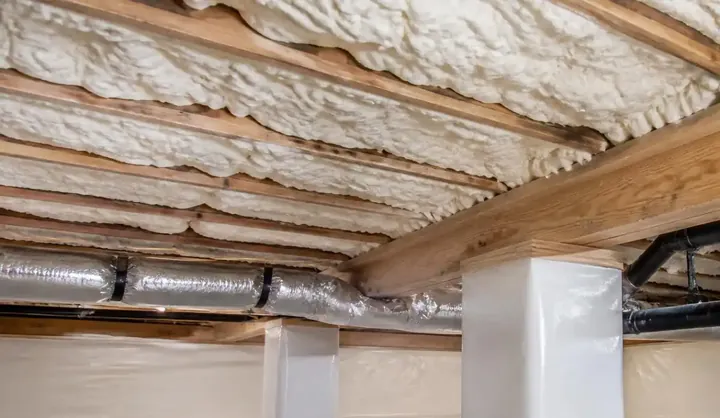
Insulation materials we use
Closed cell spray foam. Sprayed onto foundation walls and rim joists, closed cell foam adheres to the surface, seals air leaks and does not absorb water. It also adds some resistance to vapor movement. It is a premium option and a strong fit for damp, humid conditions.
Rigid foam board. Panels of extruded or foil-faced polyiso foam are cut to fit and fastened to the walls, with seams and edges sealed. Foam board is a moisture-tolerant, cost-effective choice for many foundation walls.
Insulation we avoid in crawl spaces. Standard fiberglass batts and loose-fill are poor choices in a space that can see humidity. We will tell you if existing batts are worth keeping, but in most cases they are not.
The right product depends on the shape of the foundation, how irregular the walls are, local conditions and budget. We recommend a material at inspection and explain why.
The process
- Inspect the existing insulation and the moisture picture. We look at what is there, how it has performed and why it failed.
- Remove failed insulation. Wet, fallen or contaminated insulation comes out during cleanout.
- Fix moisture first. Drainage, leaks and vapor barrier work come before new insulation. New insulation over an unsolved moisture problem fails again, usually faster.
- Seal vents and gaps. Air leaks reduce the value of any insulation. See vent sealing.
- Install the insulation. We apply spray foam or fit and seal foam board to walls and rim joists, depending on the plan.
- Finish and verify. We check coverage, seal edges and make sure the space is ready for conditioning with a dehumidifier.
Signs your crawl space insulation has failed
Insulation failure is often invisible until it is severe. Here is what we look for.
- Batts sagging, hanging or lying on the ground
- Insulation that is discolored, wet or smells musty
- Visible mold or staining on insulation or the subfloor above it
- Floors that feel cold in winter or damp in summer
- Rusted wire supports or fasteners
- Evidence of rodents or other pests nesting in the insulation
- Ductwork that sweats or drips
- High energy bills that do not match the size of your home
Benefits of the right crawl space insulation
Comfort. Warmer floors in winter and a house that is easier to keep cool in summer.
Moisture control. Insulation that does not absorb water, working together with a sealed space, reduces the conditions that feed mold and rot.
Energy efficiency. A sealed, insulated crawl space reduces how hard your heating and cooling work. How much you save depends on the home, the ductwork and the insulation, so we do not promise a specific number.
Protection for ductwork and plumbing. Keeping these inside the conditioned envelope reduces condensation on ducts and reduces freeze risk for pipes during cold snaps.
A cleaner crawl space. No fallen insulation, no pest nests, no soggy material to clean up later.
What crawl space insulation costs in Charleston
Cost depends on the area to be insulated, the material we use and the condition of the walls. Foam board is generally the less expensive choice, and spray foam costs more but covers irregular surfaces and seals air leaks as it goes. Removing old insulation, sealing the space and doing moisture work first are part of the total. We give you a written scope after inspection, and our cost guide shows planning ranges, including wall insulation as an add-on.
Why Charleston homeowners choose us
Our background is in mold inspection and remediation, which is why we focus on what the insulation will be exposed to rather than just what is cheapest to install. We replace failing products with materials that fit Lowcountry humidity and pair the work with the moisture control that keeps it dry. We work in neighborhoods from the peninsula to West Ashley, James Island and Daniel Island.
Common crawl space insulation mistakes
Insulation gets installed incorrectly more often than almost any other part of a home, and in a damp crawl space the mistakes cost more.
Fiberglass in a vented, humid space. It is cheap and fast, and in Charleston it often fails within a few years, leaving a soggy mess under the floor.
Insulating over a wet problem. New insulation over standing water, a leak or a damp dirt floor gets wet again quickly.
Insulating the floor and the walls. Doing both can trap moisture in the floor system and makes it hard to find problems later.
Leaving gaps and the rim joist open. Air leaks at the rim joist, vents and penetrations undo much of what the insulation does.
Ignoring ductwork. Ducts running through an unconditioned crawl space lose energy and sweat. Bringing them inside the sealed envelope fixes both.
Hiding damage. Spray foam over rotted or moldy wood hides the problem and makes the repair harder. We inspect and correct first.
Questions to ask any contractor about crawl space insulation
- What product will you use, and why that one for a humid crawl space?
- Will you remove the old insulation, and what happens to it?
- How will you handle moisture, vents and air leaks before insulating?
- Are you insulating the walls, the floor or both, and what is the reasoning?
- What does the product cost per square foot, and what is the coverage?
- How will the finished space be kept dry?
Straight answers to these tell you most of what you need to know.
How insulation choices affect the whole system
Insulation does not work in isolation. A foam-insulated wall in a crawl space with open vents and no liner still sits in a damp environment. A well-insulated space with a failed dehumidifier will drift back toward the outside humidity. That is why we treat insulation as one layer of a system and choose it based on how the rest of the space will be managed. When the liner, vents and drying are in place, insulation can do its job of keeping surfaces warm enough that humid air has no cold surface to condense on.
Frequently asked questions
Is spray foam or foam board better for a crawl space?
Both work. Spray foam seals air leaks and conforms to irregular walls, while foam board is a cost-effective, moisture-tolerant option for flatter walls. We recommend one after seeing your foundation.
Should I replace my fiberglass insulation?
If it is wet, sagging, moldy or fallen, yes. Fiberglass in a humid crawl space usually fails. Replacing it with the same product tends to fail again.
Can I insulate the floor and the walls?
You generally choose one approach. In a sealed crawl space, insulate the walls and leave the floor system without batts. Doing both can trap moisture in the wrong place.
Does insulation stop moisture?
Closed cell foam resists water absorption, but insulation is not a vapor barrier or a drainage system. It works best together with a liner, sealed vents and a dehumidifier.
Will insulation keep pests out?
It will not stop them, but removing old fiberglass takes away a favorite nesting material. Sealed vents and a cleaner space also reduce access.
How long does the work take?
Most insulation jobs take a day or two once the space is clean and dry, longer if cleanout or repairs come first.
Is your crawl space insulation doing its job? Call for an inspection.
Call (877) 720-8173