
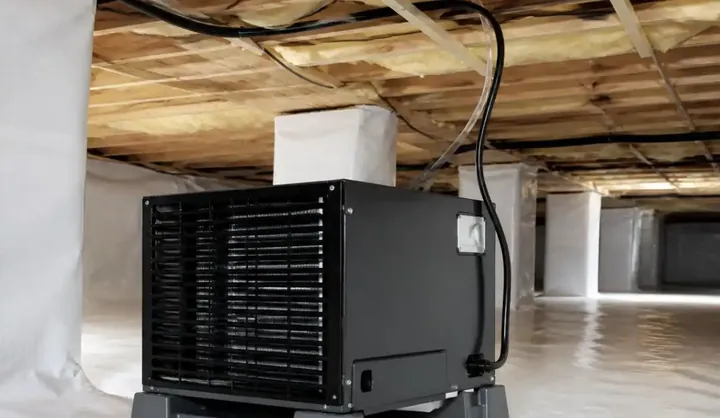
Crawl space encapsulation in Avondale
Avondale is a long-established West Ashley neighborhood near the Ashley River, centered around Savannah Highway and the small shopping district at Avondale Point. It is one of the more walkable parts of West Ashley, with neighborhood restaurants, local shops, small parks and tree-lined residential streets.
The homes here are mostly modest, mostly mid-century and mostly built on crawl spaces. Many have been updated inside, and many have not been touched underneath. We help Avondale owners find out what their crawl spaces are doing and fix the moisture problems that come with this climate.
What makes Avondale crawl spaces different
Mid-century construction. Most houses date from the 1940s through the 1960s, built with the materials and moisture assumptions of that era. Vented crawl spaces, fiberglass insulation and thin or missing ground cover were standard.
Flat terrain near the river. West Ashley is generally low and flat, and Avondale sits close to the Ashley River and its marshes. Water drains slowly.
Small crawl spaces with low clearance. Cottages and ranches often have low crawl spaces with limited room to work, which affects equipment and installation methods.
Updated interiors, original undersides. A lot of houses here have been renovated, with new kitchens, floors and HVAC, while the crawl space remains original.
Neighboring commercial activity. Proximity to Savannah Highway means busy roads, shared drainage and varied lot shapes.
Homes in Avondale
Typical Avondale houses are one-story cottages, small ranches, bungalows and a few two-story homes. Exteriors may be brick, wood siding or a mix. Many have additions at the rear, converted porches or carports turned into rooms.
Foundations are generally brick or block piers with skirt walls or full perimeter walls, with vents spaced around the perimeter. Floor systems are usually wood joists on wood beams, with subfloors of planking or plywood, depending on the decade. Ductwork added for central air runs through the crawl space, often with failing insulation and loose connections.
These houses are typically small enough that a complete encapsulation is a manageable project, and the benefits are noticeable: drier air, less odor and more comfortable floors.
Water, soil and flood conditions in Avondale
Low, flat lots. Many properties drain slowly and hold water after storms.
Proximity to the Ashley River. Tidal influence, storm surge and high groundwater affect lots near the water.
Heavy summer humidity. Vented crawl spaces take in humid air that condenses on cooler surfaces.
Standing water in low corners. Lots that sit below the street or neighboring yards can see water under the house after heavy rain.
Mature vegetation. Trees and shrubs shade the soil and add organic debris under homes.
Crawl space problems we see in Avondale
- Aged fiberglass insulation, sagging and moldy
- Original vents, some damaged or open to critters
- Bare dirt floors or thin torn plastic
- Mold on joists and subfloor, especially under bathrooms and kitchens
- Rusted and sweating HVAC ductwork
- Rot at sill plates and floor joist ends
- Low-clearance spaces where debris has accumulated unreachably
- Moisture damage near plumbing penetrations
- Floors that feel cold, soft or uneven
What we usually recommend in Avondale
Cleanout with low-clearance equipment. Tight crawl spaces need patient work and the right tools. See cleanout.
Mold treatment. Growth on joists and subfloor is cleaned and treated. See mold remediation.
Repairs. Rotted sills and joists are reinforced or replaced. See crawl space repair.
Drainage where water collects. Low corners and flat lots often need drainage and a sump pump.
A sealed liner and vents. A reinforced vapor barrier and sealed vents stop moisture at the source.
A properly sized dehumidifier. See dehumidifier installation.
Insulation and ductwork. Foam board or closed cell foam replaces batts and puts ducts inside the sealed space.
The result is a complete crawl space encapsulation.
Signs it is time to call in Avondale
If you live in an Avondale cottage or ranch, some symptoms are common enough that we hear them in nearly every call.
A musty smell in the closet, bathroom or hallway. Floors that feel cold in winter and damp in summer. Doors that stick when the weather turns humid. An air conditioner that runs constantly without drying the house. Rust on the ductwork you can see through the access door. Pest activity in the crawl space or garage. A home inspection report that mentions moisture or mold.
Any one of them is a good reason to call. Together they almost always point to the crawl space.
The process in an Avondale home
- Inspection. We check moisture, framing, ducts and access, and photograph the findings.
- Plan. You receive a written scope and price.
- Cleanout, treatment and repairs. The space is cleaned and damaged wood is fixed.
- Drainage. Installed where water collects.
- Sealing. Liner, vents and penetrations are closed.
- Conditioning. Insulation and dehumidifier complete the system.
- Walkthrough. We review the finished space with you.
A closer look at Avondale
Avondale has a village feel that is rare in West Ashley. Locals walk to dinner, kids ride bikes to the park and the houses are close enough together that neighbors talk over the fence. Many of the homes were built as modest cottages for families who wanted to be near the river and the road into town, and they still carry that scale.
That scale is useful for crawl space work. Spaces are small enough to seal in a short job, and the volume is easy to condition with a single properly sized dehumidifier. The tradeoff is clearance. Low spaces limit equipment and make cleanout slower, so crews work with low-profile tools and patience.
The common thread across Avondale is the combination of age and update. Interiors have been modernized, kitchens redone and HVAC replaced, while the crawl space is the same as it was in 1955. New ductwork in an old crawl space is a particular problem, because cold air moving through damp, unsealed space produces exactly the condensation that corrodes metal and feeds mold.
Keeping an Avondale crawl space healthy
A few habits go a long way. Check the dehumidifier twice a year. Keep gutters clear, since small houses have little margin when roof runoff lands at the foundation. Keep the area around the access door clear so you can see the space easily. After storms, take a quick look for water. And if you plan a renovation, ask the contractor to coordinate with us so new plumbing or ductwork does not compromise the liner.
Working in a walkable neighborhood
Avondale lots are close together and streets are active, so we keep job sites tidy and considerate. Equipment staging, debris removal and parking are planned in advance, and we tell neighbors what to expect when work is going to be noisy. Many owners are home during the job, working from a spare room or watching from the porch, and we make sure someone is always available to answer questions. The goal is for the neighborhood barely to notice we were there, except that your floors feel better afterward.
Local rules and practical notes
Flood zones. Some Avondale properties are in mapped flood zones, particularly near the river. Confirm requirements before altering engineered flood vents.
HOA and neighborhood rules. Most of our work is inside the foundation and does not change the exterior. If you have an HOA or historic overlay, check on any exterior work.
Access. Many crawl space doors are small. We plan for limited access.
What crawl space work costs in Avondale
Cost depends on size, clearance, debris, drainage and repairs. Smaller cottages with dry crawl spaces are simpler. Low clearance, wet soil and rotted framing add to the cost. We quote after inspection. See the cost guide for planning ranges. Nearby neighborhoods such as St. Andrews and Old Windermere share similar housing.
Frequently asked questions
Is my Avondale crawl space too small to encapsulate?
Rarely. Low-clearance spaces are workable with the right equipment and patience, though access can affect labor and cost.
My house is brick. Does that matter?
Brick exteriors do not keep moisture out of the crawl space. Foundation vents and ground moisture still bring humidity in.
Will it help my air conditioning?
Often. A sealed, dry crawl space reduces moisture in the air your cooling system treats, and brings ducts inside the envelope.
Can you do the job around other renovations?
Yes. We coordinate with other contractors where needed.
Do I need to leave while you work?
Most homeowners stay at home. The work happens under the house.
How do I get an inspection?
Call (877) 720-8173 and tell us your street and what you are noticing.
Own an Avondale cottage? Call and we will check what is going on under the floor.
Call (877) 720-8173